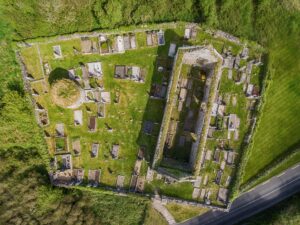
What makes it quietly arresting is not its size but its designation: the 1916 Ordnance Survey six-inch map marks this spot simply as "Ancient Grave", a label that is both matter-of-fact and oddly affecting, as though the cartographers felt no further explanation was needed or possible.
The cairn itself measures roughly two metres east to west and just over a metre north to south, rising to somewhere between half a metre and seventy centimetres in height. It is aligned east to west, a orientation commonly associated with prehistoric funerary monuments across Ireland. At its southern edge, a single exposed stone, about a metre long and fifteen centimetres thick, may be a remnant of a cist, a type of small stone-lined burial box typically dug into the ground or built into the base of a cairn to contain human remains. Whether the cist, if that is what it is, survives intact beneath the accumulated stone and vegetation is unknown. The monument has not been excavated, and the mound's overgrown condition means its full extent is difficult to assess from the surface alone.