That much is ordinary enough. What marks it out is a smooth circular basin, roughly 25 centimetres across and just five centimetres deep, worn into its upper surface, and below that a second hollow formed by the merging of three natural depressions in the rock. One corner of the base has broken away. The stone has, in other words, a complicated biography, part shaped by human hands, part shaped by geology, and it has ended up repurposed as building material, carrying its carved basin into a new role without anyone bothering to explain why.
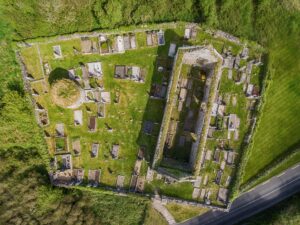
Bullaun stones are a familiar, if not fully understood, feature of early medieval Ireland. They are typically large boulders or slabs with one or more deliberately ground basins, found most often in association with ecclesiastical sites. Their precise function remains debated; collected rainwater in the basins was sometimes credited with curative properties, and the stones are often linked to the veneration of local saints. This particular example stands at the site known as Cowlnabrawher, also recorded under the name Cill-mic-an Donáin, a medieval church site in Leana. The name Cill-mic-an Donáin suggests a foundation associated with a figure named mac an Donáin, though the historical identity of that person is not firmly established from what survives. The stone now forms part of the wall enclosing the ruined site, absorbed into the fabric of a later boundary rather than left in any original position, which makes reading its original context a matter of inference rather than certainty.