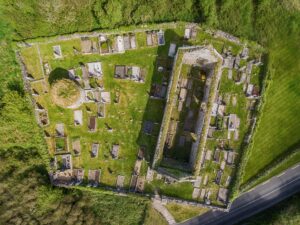
It is roughly eleven metres long and just over a metre high, and its only visible hint of what lies beneath are two upright stones protruding from the north side, set about two metres in from the edge. This is a cairn, a prehistoric burial or marker mound typically constructed from loose stone and earth, and while it looks modest from any angle, its surroundings tell a more layered story.
The cairn forms part of an extensive ancient field system, a network of boundary walls and enclosures that once organised this stretch of the Burren landscape. The mound itself sits along a north-east to south-west wall, and at its south-western end it is abutted by a later enclosure, one that was clearly added after the cairn was already in place, opening out to the north-west. Around eleven metres further to the south-west lies a fulacht fia, a type of site associated with prehistoric cooking, typically identified by a horseshoe-shaped mound of burnt and shattered stone beside a trough that was once filled with water and heated using fire-cracked rocks. A second cairn of similar character sits approximately a hundred metres to the north-north-east, suggesting this part of Parknabinnia was a place of sustained and overlapping human activity across several periods. Jones and Walsh noted all of this in 1996, setting the site within what is a remarkably dense concentration of prehistoric remains across the wider Burren.