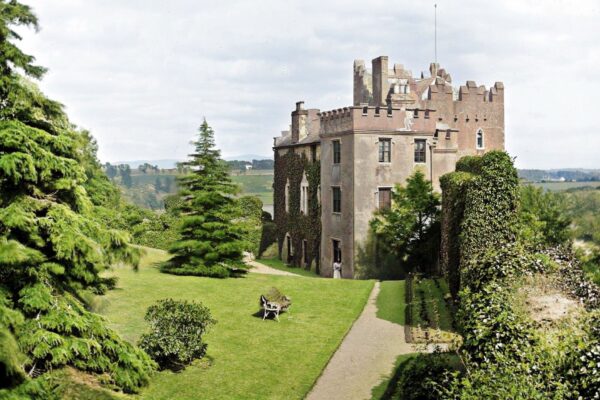
Castle, Knockeevan, Co. Tipperary South
Co. Tipperary |
Masonry Castles
In the townland of Knockeevan in South Tipperary, the remnants of a 17th-century castle tell a story of Ireland's turbulent past through little more than fragments of stone.
The Civil Survey of 1654-6 records that Piers Butler, an Irish Catholic, owned the lands of 'Knockynanamy', now identified as modern Knockeevan, where a castle once stood prominently enough to be marked on the Down Survey map of 1655-6. Today, no trace of this castle remains above ground; even Knockeevan House, which stood near the presumed castle site, has been demolished, leaving only a ruinous walled garden and outbuildings as witnesses to centuries of history.
The most intriguing survivor is a 30.6-metre length of limestone rubble walling, roughly coursed and standing 2.3 metres high, incorporated into the southern wall of the old garden. This substantial structure, terminating with large limestone quoins at either end, is thought to be the northern bawn wall of the original castle or perhaps part of a 17th-century house that succeeded it. The wall's construction reveals its age through several telling details: the eastern quoins survive to 1.9 metres, whilst the western ones reach 1.4 metres, consisting of three massive limestone blocks. Above these original features, later modifications are evident where the wall was rebuilt and adapted for the garden.
Scattered throughout the wall are tantalising architectural fragments that hint at the castle's former grandeur. Several cut stone pieces have been repurposed in the later construction, including blocks with chamfered edges, drafted margins, and peck-tooling; telltale signs of skilled 17th-century masonry work. One fragment shows what appears to be a rebate, possibly from a window or doorway, whilst another curved limestone block might have formed part of an arch. These architectural remnants, some positioned over two metres above ground level, serve as a three-dimensional jigsaw puzzle, offering glimpses of the sophisticated stonework that once adorned Butler's castle before time, politics, and practicality saw it reduced to building material for a garden wall.
Visitor Notes
Added by