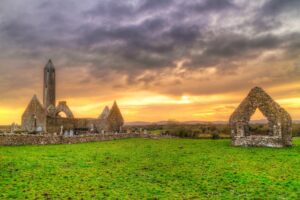
The 1916 Ordnance Survey six-inch map recorded it thus, already noting it as a ruin, which places its abandonment well before the early twentieth century and lends the site a particular kind of quiet obscurity, known to cartographers long after it ceased to function.
The structure is a Roman Catholic church of the eighteenth or nineteenth century, built from roughly coursed drystone, a technique in which stones are laid without mortar and shaped by hand rather than cut. The walls survive to between 0.6 and 1.5 metres in height and range from 0.6 to 0.9 metres thick, double-faced on both sides. The main body of the church runs northeast to southwest along the line of the ridge, with an extension projecting from the northeast end, built at the same time as the main structure. Two doorways remain legible: one at the northeast end, 1.45 metres wide, and a narrower opening of 1.05 metres on the south wall of the main church. Inside the northeast door, a crudely inserted secondary wall was added at some point after the original construction, dividing the extension from the main body of the building. Why it was put there is not recorded, but its rough workmanship sets it apart from the rest of the fabric, suggesting a pragmatic afterthought rather than any planned alteration.