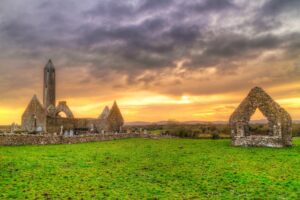
No wall encloses it, no inscribed stone names anyone buried here. The area measures roughly fifteen metres by nine, and the graves within it are oriented east to west in the old Christian manner, yet the site sits outside the formal structures of parish life that would normally govern burial. Places like this, known in Irish as cillíní, were used across Ireland for infants who died before baptism, and sometimes for others considered marginal to the official Church, interred quietly in marginal ground.
According to the landowner, the last child was laid here in the 1920s, which makes this a living memory site rather than a purely ancient one. There is also a local tradition that a penal priest is buried among the graves. Penal priests were Catholic clergy who continued to minister during the Penal Laws, a series of statutes from the late seventeenth and eighteenth centuries that severely restricted Catholic worship and made the open practice of the priesthood dangerous. Being buried alongside unbaptised children, rather than in consecrated ground, would have been a quietly subversive act of solidarity, or perhaps simply a matter of necessity. The landscape around the site adds further layers: a holy well lies approximately fourteen metres to the south-south-east, and a bullaun stone, a large rock bearing one or more carved circular depressions thought to have been used for grinding or ritual purposes, sits around a hundred and eighty metres to the west-north-west. The clustering of these features suggests the area carried some older sacred significance well before it became a place of marginal burial.