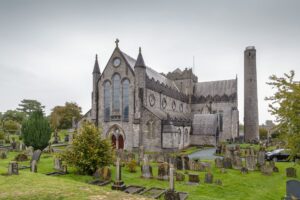
This is what remains of Kilmologga, a pre-Norman parish church whose name preserves the memory of St Molaga, or Malog, a saint said by tradition to have come from Wales to assist St Patrick in his missionary work. The setting is about as far from the conventionally sacred as it is possible to imagine, yet the stonework itself is old enough to predate the Anglo-Norman arrival in Ireland entirely.
Writing in 1905, the historian William Carrigan described the church as having both gables gone and its side-walls standing to a height of roughly six to eight feet, noting a small window in the north wall that was round-headed on the inside and, in his word, unmistakably Celtic. He dated the building to the eleventh century. What survives today is considerably less than Carrigan saw: only a portion of the north wall of the chancel, standing to about 2.2 metres, and a short stub of the nave wall remain upright, while the footings of the east gable and south wall are buried under fallen masonry. The church is built of roughly coursed sandstone rubble and measures roughly nine metres east to west by seven metres north to south internally. In the chancel's north wall, a pointed window embrasure is still legible, along with a small rectangular aumbry, a niche built into the wall to hold liturgical vessels, and two putlog holes, the sockets that once held the timber scaffolding used during construction. The parish of Kilmologga was absorbed into the holdings of the Priory of St John in Kilkenny before 1300, and at the Reformation it was merged into the parish of St John's, Kilkenny. There is no enclosed graveyard associated with the site, which makes its isolation among warehouse units feel stranger still.