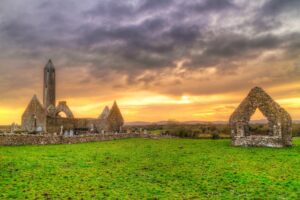
Its south wall, standing to roughly four metres, carries two windows side by side that do not match: one has a pointed arch, the other a rounded one, a pairing that quietly signals different periods of use and alteration layered on top of each other across the medieval centuries.
The church is a nave and chancel structure, oriented east to west in the standard medieval fashion, measuring about thirteen metres in length and five and a half metres in width. A nave and chancel plan divides the building into two sections, the nave for the congregation and the chancel, at the east end, reserved for the clergy and the altar. As Peter Harbison noted in 1970, the chancel here was a later addition to the original nave, meaning the building grew in stages rather than being conceived all at once. A fragment of another window arch is still visible in the chancel's south wall, a ghost of an earlier opening that was at some point blocked or altered. Most of what stands today has been substantially reconstructed and re-pointed over the years, leaving only the outer portion of the chancel arch and that south wall as the more genuinely early fabric. Fahy, writing in 1895, and O'Flanagan in 1927, both recorded the church as part of a wider attempt to document the Kilmacduagh complex, which grew up around the sixth-century saint Colmán mac Duagh and became one of the more significant ecclesiastical settlements in south Galway.
The church sits roughly fifty metres to the north-northeast of the great cathedral at Kilmacduagh, itself famous for its dramatically leaning round tower. Visitors who make for the tower and cathedral, as most do, often pass this smaller building without stopping. The mismatched windows in the south wall are easy to overlook unless you are specifically looking for them, but they repay a few minutes of close attention as a small, legible record of how medieval religious communities built incrementally, in fits and starts, according to changing needs and available resources.