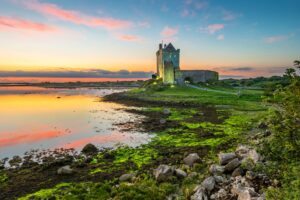
The house that sits within it, known as Dooros House, is not a ruin in the conventional sense, nor a fully preserved country seat, but a place whose significance has as much to do with who passed through it as with its architecture or estate history.
Doorus Demesne is most closely associated with Count Florimonde de Basterot, a French-Irish aristocrat who inherited the property in the nineteenth century and used it as a kind of informal gathering point for literary and intellectual visitors. It was here, in the summer of 1897, that W. B. Yeats and Lady Augusta Gregory met with Edward Martyn at the nearby Tulira Castle and, in subsequent conversations at Doorus, began sketching out the idea that would become the Irish Literary Theatre, the forerunner of the Abbey Theatre. The house and its setting, poised between the flat limestone of the Burren coast and the open water of the bay, provided the backdrop for one of the more consequential informal meetings in modern Irish cultural history. De Basterot himself was a writer and essayist with connections across European literary circles, and Doorus under his tenure had an atmosphere quite distinct from the typical Anglo-Irish demesne of the period.
The demesne is accessible from the road between Kinvara and Doorus, and the landscape around it, low-lying, windswept, and edged with water on three sides, gives a clear sense of why the place felt set apart from the world. The house itself has passed through various hands since de Basterot's time and its present condition rewards a cautious look rather than any expectation of a well-maintained showpiece.