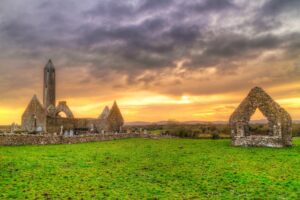
This one, on the flat karst limestone of Ballaghaglash in County Clare, earned a footnote by what it turned out not to contain at all. It was listed as a hut site in the Record of Monuments and Places in 1996, the kind of designation that implies ancient settlement, a scrap of enclosure wall, perhaps a hollow in the ground where someone once sheltered. When a surveyor eventually visited in 2000, none of that was there.
The backstory is modest but telling. The site had been flagged on a set of annotated maps in 1994, passed along through personal communication rather than any formal excavation or field report. By the time someone went to look, the landscape had quietly rearranged itself. Two fields, their boundaries clearly marked on the 1916 Ordnance Survey six-inch map and defined by drystone walls of modern construction, had been merged into a single larger field. The walls that once divided them were gone. Whatever feature had originally prompted the "hut site" label, whether a low mound, a peculiar arrangement of stones, or simply an optimistic reading of the map, had left no trace on the ground. The karst terrain, with its characteristic exposed limestone pavement and tendency to swallow or obscure surface features, does not make such assessments easy at the best of times.
What lingers is the gap between the record and the reality. The site sits in a category familiar to anyone who has worked with early heritage inventories: the monument that exists on paper long after the ground has moved on, a placeholder for something that may once have warranted attention, or may simply have been a mistake that took six years and a site visit to formally correct.