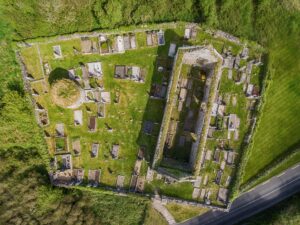
It is the kind of feature that a passing walker might read as a natural rise in the ground, yet maps stretching back nearly two centuries tell a different story.
The site first appeared on the Ordnance Survey's six-inch map of 1842, classified at that time as a ringfort, the term used for the enclosed farmsteads of early medieval Ireland, typically dating from roughly the sixth to the twelfth century. By the time the OS 25-inch plan was produced in 1897, surveyors were recording a scarped raised circular area whose outline also happened to carry part of the townland boundary dividing Bunnanagat South from Monanaleen, running from the south-west around to the north. The Cassini edition of the six-inch map, published in 1920, reclassified it more cautiously as an enclosure, a shift in language that reflects how the monument's true character had become harder to read. The sequence of mapping, from 1842 through 1897 to 1920, offers a small window into how surveyors understood and reinterpreted the same earthwork across successive generations.
More recent aerial imagery tells a less encouraging story. The field boundaries that once followed the scarp from the south-west around to the north and east have since been removed, and a later field wall now cuts directly north to south across the monument itself. The enclosure survives, but the landscape around it has been reorganised in ways that have obscured the relationship between the earthwork and the older boundaries that once traced its edges.