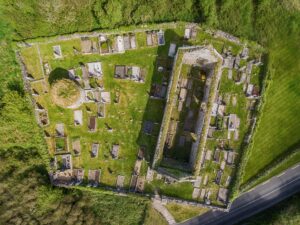
What survives today amounts to little more than a faint ripple in the grass, the ghost of a boundary that once enclosed a roughly circular space some thirty metres across.
Enclosures of this type, subcircular earthworks defined by a bank and sometimes an internal counterscarp, a low internal ledge of earth that helped define the enclosed space, are a common feature of the Irish rural landscape. They are generally associated with early medieval settlement, serving as farmsteads or occasionally as ringforts. This particular example was substantial enough to be recorded on the first edition of the Ordnance Survey six-inch map in 1842, and again on the Cassini edition of 1920, marked each time with the short radiating lines, called hachures, that cartographers used to indicate earthwork banks. By 1998, however, field inspection found that clearance works had already truncated the western side of the monument. At that point, parts of the perimeter were still traceable: a spoil bank obscured the northern arc, a sparse scatter of stones and bushes marked the eastern side, and a low counterscarp survived along the southern edge. In the years that followed, satellite imagery suggests even those remnants were cleared away, along with a field wall that had formed at the western edge. What remains visible in more recent imagery is a faint grass-covered scarp along the northern and eastern arcs, barely legible from above and almost certainly invisible at ground level without careful searching.