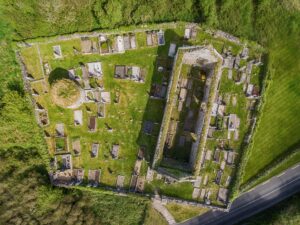
What makes it quietly arresting is not grandeur but persistence: a rough oval of tumbled stone, barely knee-high in places, still legible enough in the landscape that it was mapped twice by the Ordnance Survey, once on the first six-inch edition of 1842 and again on the Cassini edition of 1920. That two generations of surveyors thought it worth marking suggests the feature was more visible then than it is now, even if it was never especially imposing.
The enclosure measures roughly 12.5 metres east to west and 11.8 metres north to south internally, placing it firmly in the category of small field or farmstead enclosures rather than anything more ceremonial. Along the western, northern, and southern arcs, the boundary survives as wall collapse, a spread of large stones two and a half to three metres wide and around half a metre high, most legible between the north-north-west and east-north-east. To the south-west, the enclosure is instead defined by a stone-strewn scarp, a low earthen or rock edge between one and one point two metres high, suggesting the original construction varied with the local topography. A later drystone wall, the kind of utilitarian field boundary still common across Clare, has been laid directly over the north-east perimeter, obscuring part of the earlier structure. Tucked against the wall collapse at the north-east are two small drystone structures, roofless now and reduced to their footprints. One sits to the north, measuring about 1.7 metres by 1.35 metres internally; the other, slightly larger at roughly 2.1 metres by 1.8 metres, sits to the south, with its western side formed not by built stone but by a natural bedrock outcrop pressed into service as a ready-made wall. Whether these small cells are contemporary with the enclosure or later additions is not recorded, but the use of raw bedrock as building material gives the southern structure a particular sense of pragmatic improvisation.