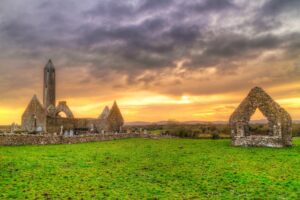
The site at Kiltacky More occupies an east-facing slope in low-lying semi-karst pastureland, that distinctive limestone landscape where the ground dissolves slowly into pavement and hollow, and where bedrock has a habit of asserting itself. This particular outcrop lifts the graveyard just enough above its surroundings to give it a quiet prominence, enclosed within a stone wall and laid out in an irregular trapezoidal shape measuring roughly fifty metres along its longer axis.
The site was already established enough by 1842 to be marked and named on the Ordnance Survey six-inch map of that year, one of the most detailed cartographic records of the Irish countryside produced in the nineteenth century. The headstones that survive date from around 1850 onwards, though a number of plain, uninscribed grave-markers suggest that burials here may predate the period when cut headstones became common. A church stands in the north-western part of the enclosure, and the road running immediately outside the south-western wall appears to have been cut directly into the bedrock at some point in the modern era, which means the living and the dead are separated here by little more than dressed stone and a slice taken from the limestone itself.