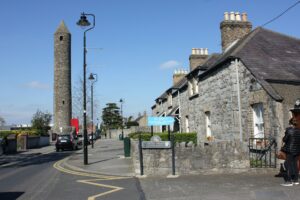
At Chapelizod, a village on the western edge of Dublin that sits along the Liffey, there was once a substantial brick mansion that the Civil Survey of 1654 to 1656 described as 'a ffayre Mansion House', complete with an entrance gateway, a courtyard, an orchard, two gardens, and a grove of ash trees planted purely for ornament. When archaeologists eventually went looking for it in 1992, they found nothing at all.
The building is recorded as the 'Kings House', a brick structure erected by Lord Valentia in the first half of the seventeenth century. Brick construction was relatively uncommon in Ireland at the time and would have marked this as a building of some social ambition. The Civil Survey, a detailed land assessment carried out in the mid-1650s following the Cromwellian conquest of Ireland, provides the most vivid snapshot of the property, capturing its ornamental planting and formal layout in the dry language of administrative record. The historian F. E. Ball, writing in 1903, drew on this source to describe the mansion, and Maurice Craig noted as late as 1982 that some traces of the structure had survived into the nineteenth century. By the time excavations were undertaken under licence number 92E0040, however, the ground had given up nothing. No foundations, no floor surfaces, no material trace of the building that had once been considered worth recording in a government survey.
Chapelizod itself is easily reached from Dublin city, and the area around the old village retains something of its historic character, sitting as it does beside the Phoenix Park. There is no marker or monument to indicate where the mansion once stood, and the 1992 excavation report, compiled by Hayden, confirms that the site has been thoroughly absorbed by subsequent development or disturbance. For anyone interested in the archaeology of absence, the area is worth a slow walk, less for what can be seen than for what the documentary record insists was once there, a formal seventeenth-century residence with ornamental grounds, now leaving not so much as a brick course behind.