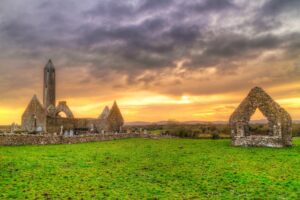
The walls themselves are a kind of archive: footings to the north of the nave reveal that the church was once considerably wider, and the present north wall is thought to have been built after an earlier one collapsed, probably sometime in the 14th or 15th century. Traces of a much earlier enclosed precinct also survive, in the form of a foundation line running for some 22 metres before turning eastward, with the remains of an arched gateway still visible where it has not been swallowed by a later field wall and vegetation.
The monastery was built by the Augustinian Canons, a religious order following the Rule of St Augustine, in the first half of the 13th century, replacing an earlier monastic foundation on or near the same site. It was raised under the patronage of the O'Heyne family, a Gaelic dynasty whose name it still carries. The church, aligned east to west in the usual fashion, retains pointed arch doorways in both the north and south walls of the nave, and the decorated capitals of columns that once supported a chancel arch now missing. In the chancel itself, the east gable holds a two-light round-headed window with hood- and roll-mouldings, the kind of decorative stonework that signals considerable ambition for its time and place. Below a narrow window in the south wall sits a piscina, a small stone basin used for rinsing liturgical vessels, confirming this as a working, furnished chancel rather than a bare shell. Beyond the church, a sequence of conventual buildings extends southward: a sacristy, a small vaulted chamber described in older accounts as the Treasury, a room that may have served as a refectory or chapter room, and the partial remains of a two-storey building whose upper doorway once opened onto the dormitories. Most of the western and southern walls of that last structure are gone.
The site sits within the broader Kilmacduagh monastic complex, one of the more substantial early medieval and medieval ecclesiastical landscapes in the west of Ireland. The marshy ground to the south-west, west, and north-north-east would once have offered a degree of natural protection and isolation; today it gives the ruins a quietly sequestered quality, set apart from the road and from the more visited round tower and cathedral nearby. The evidence of restoration at different periods, noted by earlier observers, means that what you see is not simply medieval fabric but a palimpsest of interventions, each generation having decided the place was worth keeping.