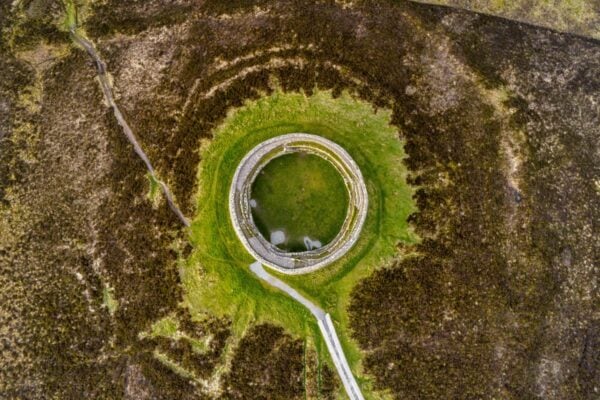
Promontory fort - inland, An Machaire, Co. Donegal
Co. Donegal |
Forts
On the northern shore of Aghnish Lough in County Donegal, a stone wall transforms a natural promontory into what archaeologists recognise as an inland promontory fort.
The defensive wall stretches from a rocky outcrop on the western side to within five metres of the eastern edge, effectively cutting off access to the jutting landform. Whilst the upper portions of the wall show signs of more recent reconstruction, with smaller stones likely added in modern times, the foundation tells a much older story; its base, measuring about a metre thick, consists of larger stones carefully positioned with their flat faces turned outward, a construction technique typical of ancient Irish fortifications.
The most intriguing feature of this structure is what appears to be an original entrance in the centre of the wall. Two stone slabs, each measuring 1.1 metres in length and positioned perpendicular to the wall, mark what was once a gateway into the fortified area. Additional slabs found on the interior northern side of the wall continue the alignment of this entrance passage, suggesting a deliberately designed access point. The original gap between these entrance stones, measuring exactly 1.11 metres wide, has since been filled with modern stonework, though the ancient threshold remains clearly visible.
This promontory fort at An Machaire represents a type of defensive structure commonly built in Ireland during the Iron Age and early medieval periods. By utilising the natural defensive advantages of the promontory, with water providing protection on three sides, the builders only needed to construct a single wall across the landward approach. Such sites often served as defended homesteads for local chieftains or as places of refuge during times of conflict, and this example, documented in the Archaeological Survey of County Donegal, stands as a well-preserved reminder of how ancient communities adapted the landscape for their protection.
Visitor Notes
Added by