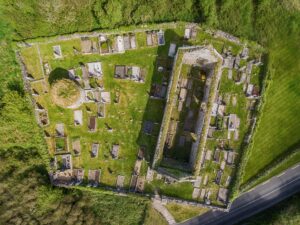
What the Ordnance Survey mapped in its first edition as an enclosure, the kind of circular or subcircular earthwork that archaeologists associate with early settlement or stock management, was reclassified by the 1916 edition as something considerably more prosaic: a quarry. The gap between those two readings, one romantic and potentially ancient, the other industrial and mundane, is the whole story of this particular spot.
The site was formally listed as an enclosure in both the Sites and Monuments Record of 1992 and the Record of Monuments and Places in 1996, inheriting its classification from that earlier cartographic interpretation. On the ground, though, what survives is modest: a slight dip backing onto a field wall at the northwest, with a collapsed drystone wall defining the southeast edge. That drystone wall, once around two metres wide and half a metre high at its tallest surviving point, has since fallen into a spread of loose stone. Drystone construction, built without mortar by carefully fitting stones together, was the standard technique for field boundaries and small enclosures across this part of Ireland, and its presence here neither confirms nor rules out an early date. The honest answer is that the feature could represent a worked quarry hollow, or it could be the ghost of something older that was later pressed into use for extraction, or both interpretations could be reaching for significance in a simple agricultural hollow.