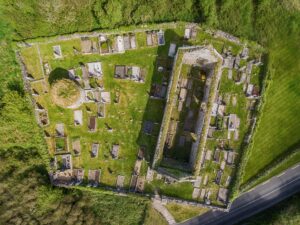
Somewhere within it, a quarry has been recorded as a monument, a designation that raises an immediate question: what kind of quarrying, and from when, warranted the attention of archaeologists rather than industrial historians?
The Burren's limestone has been worked for centuries, cut for field walls, buildings, and the distinctive flat-faced slabs used throughout the region. In some cases, quarrying activity in the area has been linked to prehistoric or early medieval land use, where the removal of stone was bound up with the construction of megalithic tombs, ringforts, or enclosures that still mark the hillsides. Parknabinnia itself is known to archaeologists as the location of a wedge tomb, a type of megalithic burial monument built roughly between 2500 and 2000 BC, characterised by a tapering roofed gallery that is wider and higher at the front than the rear. Whether the recorded quarry relates to that prehistoric activity, to medieval farming, or to more recent extraction is not currently documented in any publicly available form.