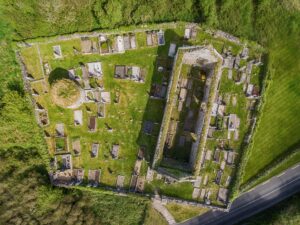
The structure is a cashel, which is essentially a ringfort built from stone rather than earth and timber, its circular enclosure once defined by a drystone wall with both inner and outer faces carefully laid. That wall is now largely a spread of collapsed rubble, but the form of the place is still legible if you know what you are looking for.
The cashel measures roughly 26 metres on its longer north-west to south-east axis and 23 metres across the other way, making it a modest but typical example of the type. Where the wall survives best, at the north-west, north-east, and south-west, it reaches up to 1.4 metres in height and retains a width of around 1.8 metres, enough to suggest real solidity in its original construction. Several gaps now interrupt the circuit, including one fitted with a gate at the north-north-east, but these openings are later additions rather than original features, the result of generations of farmers adapting a prehistoric boundary to their own needs. The site was recorded on Ordnance Survey six-inch maps in both 1840 and 1916, which means it was already a visible landscape feature well before modern archaeological recording began. By 1996 it had been formally catalogued, though described at that point only as an enclosure, a cautious label that leaves open questions about its precise date and function that the stonework alone cannot settle.