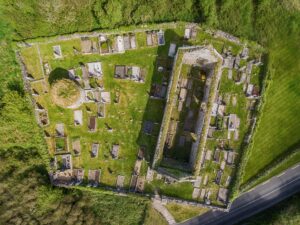
A cashel is a ringfort built from dry-stone walling rather than earthen banks, a construction technique particularly common in the west of Ireland where stone was plentiful and readily worked. These enclosures were typically the farmsteads of early medieval Ireland, home to a single family and their livestock, and the cashel form gave them a more permanent, defensible boundary than an earthen rath could provide.
Ballyportry itself is a townland whose name suggests older layers of occupation and use, and the presence of a cashel here fits a broader pattern across Clare, where the karst limestone of the Burren and surrounding areas made stone construction the natural choice for generations of early farmers. Cashels of this kind generally date to the period between roughly the fifth and twelfth centuries, though many continued in use or were adapted well beyond that span. The particular history of this example, its builders, its dimensions, and any finds or features associated with it, remain to be fully documented in the public record.
The townland lies in a part of Clare where ringforts of various kinds appear with some regularity, often marked by slight rises in the ground or by the persistence of old field boundaries respecting a circular space. Visitors to the area who have an eye for the subtle geometry of early medieval enclosures may find it worth looking for the characteristic curve of a stone wall breaking the otherwise irregular lines of the countryside.