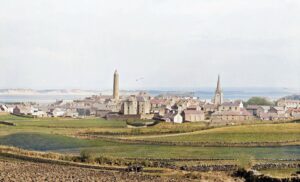
The structure was levelled at some point in the past, and today what survives is less a monument than a trace: a very low circular platform, roughly 38 metres across, its outline readable mainly as gentle undulations in the pasture grass and, in the right conditions, as cropmarks in the soil. Outside the platform, remnants of two fosses, each about two to two and a half metres wide, survive alongside an intervening bank, though a rectangular paddock cuts across the eastern edge and a farm track bisects the southern half, both obscuring sections of what was once a complete circuit.
A rath is an early medieval ringfort, typically an enclosed farmstead of the kind that was once extraordinarily common across Ireland, usually consisting of an earthen bank and ditch surrounding a family's dwelling and outbuildings. What is unusual here is not the rath itself but its landscape context. Five more raths lie within a radius of roughly half a kilometre, distributed to the west, north-west, north-north-west, north-east, and east-north-east. Taken together, they suggest this elevated ground above the Palmerstown River was a settled and organised farming territory during the early medieval period, with individual enclosed farmsteads positioned across the plateau in something close to a cluster. More striking still, approximately 70 metres to the north sits a court tomb, a Neolithic megalithic structure typically dating to around 4000 BC, predating the raths by several thousand years. The rath at Carbad More, then, occupies ground that was already old when its builders arrived.