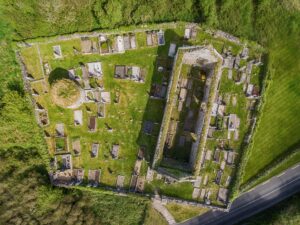
It sits within a cashel, a type of early medieval stone-ringed enclosure typically used to protect a farmstead or settlement, and its position in the south-south-western interior is consistent with how souterrains were often placed within such sites. A souterrain is an underground stone-built passage or chamber, usually associated with early Christian period settlements in Ireland, and thought to have served purposes ranging from storage to refuge. The word itself is Old French for "underground," though the structures are thoroughly Irish in their distribution and character.
The feature at Poulaphuca has been classified only as a possible souterrain, the caution warranted by the fact that what survives is an irregular, stone-filled hollow rather than any visible structural stonework. The dimensions, approximately three metres on the north-east to south-west axis and one and a half metres on the north-west to south-east, are modest, and without excavation it remains uncertain whether a built passage lies beneath or whether the hollow represents collapse, robbing of stone, or something else entirely. Its association with the cashel at this site is the primary reason it has been noted at all; souterrains were commonly attached to cashels across Munster and beyond, making the combination suggestive even where direct evidence is thin.