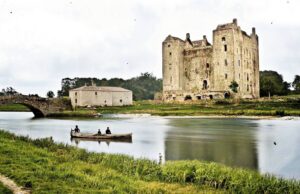
Yet somewhere under the modern roads and hotel foundations lies the buried outline of a medieval town's defences, described in a fourteenth-century Irish text as 'broad-based high-crested ramparts, running from the stream to the sea'. That description comes from the Caithréim Thoirdhealbhaigh, a narrative account of the wars of Thomond, and it is one of the more evocative pieces of evidence that Bunratty was once a functioning walled borough rather than simply a castle with a view.
The physical evidence has emerged piecemeal, largely as a byproduct of construction work. In 1991, monitoring of foundation trenches dug for an extension to the Shannon Shamrock Hotel revealed a ditch more than 8.5 metres wide, running east to west, with finds dating it to the thirteenth or fourteenth century. A second round of test trenching in 2000, carried out ahead of a housing development nearby, uncovered another substantial ditch of similar width and the same east-west alignment, almost certainly the same feature encountered nine years earlier. Together, the two investigations point to a defensive ditch of considerable scale encircling the medieval borough. The picture is complicated slightly by earthworks around the site that were long assumed to be Viking or Anglo-Norman fortifications; more recent analysis has dated these to the seventeenth century, and they are now understood as reclamation banks built to protect the low-lying land from spring tide flooding rather than as military works. The medieval defences and the post-medieval land management have, over the centuries, been quietly conflated in local interpretation.