A water mill is exactly what it sounds like: a structure using the flow of a river or stream to turn a wheel and drive millstones, typically for grinding grain. That such a mill once operated here is not in dispute. What is striking is the unbroken thread of industrial use that has kept the site in continuous service, from medieval milling to paper manufacturing to retail, erasing each previous layer almost completely.
The Urban Survey of County Dublin records that a water mill was associated with the manor of Clondalkin from at least the thirteenth century, and by 1326 it had been formally valued at 38 shillings and 10 pence. That valuation appears in records cited by McNeill, giving the site a paper trail that stretches back nearly seven hundred years. The same survey suggests the location is almost certainly the site later occupied by the paper mills on the north side of the road to Newcastle Lyons, and that this is likely the same mill visited in 1780 by the antiquarian Austin Cooper, who noted its castellated appearance, meaning it had been built or modified to include battlemented stonework more typical of a fortified structure. A later researcher, Ua Broin, documented additional mills in the area, though whether any of those predate the eighteenth century remains unclear.
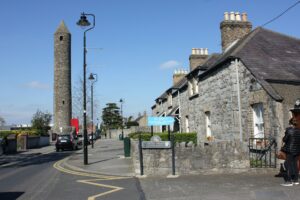
There is nothing to see at the site today. The Mill Centre Shopping complex stands on or very close to the original mill location, and no surface remains are visible. The value of coming here, if value there is, lies in the layering: standing in an ordinary suburban car park and knowing that somewhere below it a thirteenth-century mill once drew water and ground grain for a medieval manor. The road to Newcastle Lyons still runs nearby. The name of the shopping centre, whether intentionally or not, preserves the only above-ground trace of what the ground beneath it once contained.