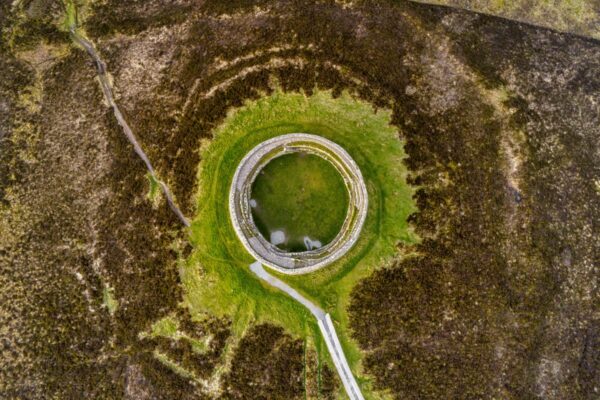
Promontory fort - coastal, Parkmore, Co. Donegal
Co. Donegal |
Forts
On the rugged coastline of County Donegal stands an ancient promontory fort that bears witness to Ireland's defensive past.
Known variously as Dunduneen Head on early Ordnance Survey maps and later as Dundonnell Head, this coastal fortification occupies a dramatic peninsula that the Atlantic has sculpted over millennia. Two inlets have carved away at the rock face, leaving behind a natural stronghold connected to the mainland by a narrow neck of land just five metres wide.
The fort's builders took full advantage of this natural geography, adding their own defensive works where the promontory meets the shore. Though time and weather have taken their toll, you can still trace the remains of three distinct features: an internal bank closest to the enclosed area, a defensive ditch or fosse, and traces of a low outer bank. Together, these earthworks once protected an impressive space measuring 100 metres east to west and 90 metres north to south. A modern field boundary now runs parallel to these ancient defences on the western side, a reminder of how the landscape continues to evolve around these historical remains.
The choice of location reveals the strategic thinking of its builders. While the fort commands views of the sea approaches, it sits somewhat vulnerably below higher ground to the north along the coast and to the northwest inland; perhaps its defenders valued the maritime access and natural defences more than the commanding heights. The surrounding landscape, characterised by thin soils and frequent rock outcrops, would have offered limited agricultural potential but excellent natural building materials for the fort's construction. This archaeological site, documented in the comprehensive Archaeological Survey of County Donegal, continues to offer insights into how ancient communities adapted to and fortified Ireland's dramatic coastal landscapes.
Visitor Notes
Added by