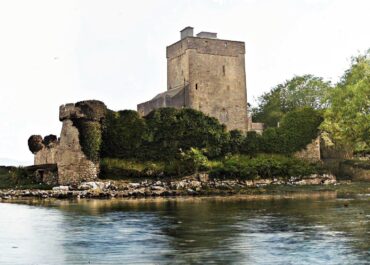
This unusual U-shaped tower, measuring 8 metres by 6.6 metres, features slight projecting turrets to the east and west, with a distinctively curved southern face between them. Built sometime before 1583, when it was held by Garrett mac Gibbon mac Reynode, the castle’s unique design has led some scholars to suggest it may have once formed part of a twin-towered gatehouse, whilst others consider it an experimental building unlike any other tower house in Ireland.
The castle’s compact but well-preserved structure includes a vaulted lower storey, a ruined staircase in the north-east angle, and a plain pointed door in the north wall flanked by distinctive batter slopes. By 1840, locals had taken to calling the 32-foot square tower “the Pigeon House”, though it stood approximately 24 feet high at that time, having apparently lost some of its original height. The Civil Survey of 1654-56 reveals that Court was then a thriving settlement with four good houses, held by the Gerrald family, with Margaret Haly (née Creagh) holding dower rights to 80 acres as widow of John Haly Esquire.
Together with the nearby Cullam Castle, positioned strategically on a hill, Court Castle formed part of a defensive network protecting the lower reaches of the Maigue. Its low, squat profile, standing almost at the river’s edge, complemented Cullam’s elevated position perfectly. The castle changed hands several times over the centuries; by 1655 it was held by Gerott mac Tibbott and associates, and by 1702 had passed to Henry Widenham. Today, this architectural oddity remains a testament to medieval Irish castle building innovation, its experimental design continuing to intrigue architectural historians who consider it potentially unique not just in County Limerick, but across the entire country.