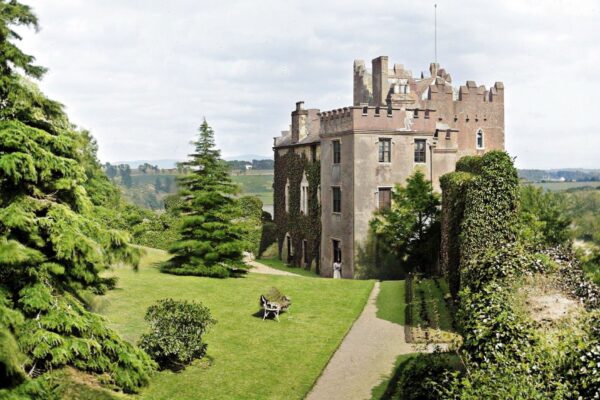
Site of Boytonrath Castle, Boytonrath, Co. Tipperary South
Co. Tipperary |
Masonry Castles
In the farmyard of a working farm in Boytonrath, County Tipperary, lie the scattered remains of what was once a formidable medieval castle.
Today, only fragments of ivy-covered masonry peek above ground level, giving little hint of the structure that once stood here. The castle ruins sit within the southwestern area of an ancient enclosure, just outside the modern farmyard boundaries, where centuries of agricultural life have grown up around these weathered stones.
When antiquarians surveyed the site around 1840, they recorded more substantial remains than what visitors see today. The castle's footprint measured roughly 12.8 metres by 6.4 metres internally, with impressively thick limestone walls spanning 1.8 metres across; built solid and grouted for strength. At that time, the tallest surviving fragment reached 3.65 metres high, though even then the castle was already largely demolished. The original structure would have been a compact but sturdy square tower, typical of the defensive architecture that dotted the Irish countryside during the medieval period.
The castle's dramatic end came not through slow decay but through deliberate destruction, most likely by gunpowder explosion. Writing in 1892, the historian White observed that the walls lay scattered about in large masses, with the masonry courses clearly showing that some sections had been blown onto their sides. This violent demolition, whether during the Cromwellian campaigns or later conflicts, left the once-proud fortress as little more than rubble in a field; a subtle reminder of Ireland's turbulent past hidden amongst the everyday bustle of farm life.
Visitor Notes
Added by