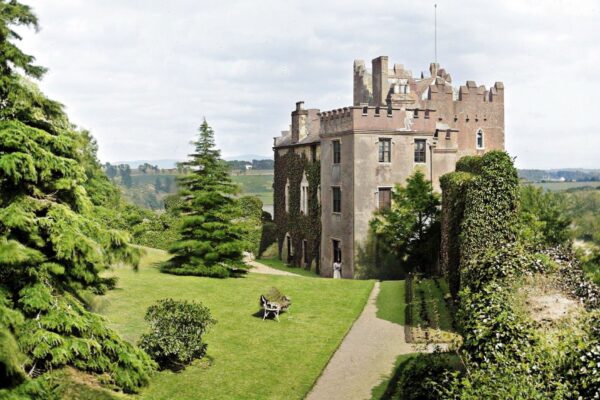
Site of Castle, Kilknockan, Co. Tipperary South
Co. Tipperary |
Masonry Castles
In the gentle pastures northwest of Kilknockan Hill in County Tipperary, the faint memory of a castle once owned by Nicholas Everard still lingers, though the structure itself has long since vanished.
The Civil Survey of 1654-6 documented Everard, an esquire of Fethard, as the proprietor in 1640, noting that his lands contained "a small castle". This fortification appears on the 1843 Ordnance Survey maps, where it's marked as a "Castle site of" and shown bisected by a farm road running west-northwest to east-southeast; the same notation persists on modern OS maps despite the absence of any visible remains.
The castle's physical presence endured well into the 20th century, with local residents recalling low wall remains about half a metre high that survived until roughly the 1970s. These last vestiges were levelled for agricultural development, and by 1982, surveyor Cahill confirmed that nothing remained of the structure. Today, visitors to the site will find only gentle undulations in the pasture fields on either side of the farm road, though these are more likely related to the settlement earthworks that once surrounded the castle rather than the building itself.
The castle didn't stand in isolation; it formed part of a larger medieval complex that shaped this corner of Tipperary. Earthworks from the associated settlement are still visible to the west, whilst approximately 40 metres to the east-southeast stand the remains of a church, suggesting this was once a thriving community centre. Though the castle has returned to earth, its documented history and the surviving features of its surroundings offer glimpses into the world of 17th-century Irish gentry and the landscapes they inhabited.
Visitor Notes
Added by