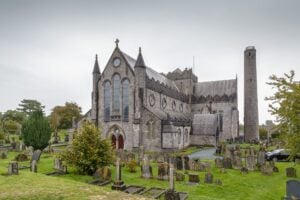
The Castle, Dukesmeadows, Co. Kilkenny

The Castle, Dukesmeadows, Co. Kilkenny

Kilkenny Castle stands on the south bank of the River Nore, positioned 12 metres above the water on a glacial terrace of limestone gravels and boulder clay.

The Castle, Dukesmeadows, Co. Kilkenny

The castle as it appears today, with its three wings facing north, west and south, largely dates from 19th-century rebuilding, but it follows the footprint of the Inner Ward of a 13th-century masonry fortress built by William Marshal, Earl of Pembroke and Lord of Leinster. Between 1207 and 1213, Marshal transformed Kilkenny into the de facto political capital of Leinster whilst in exile from King John’s court; the castle became so grand that in 1210 it hosted the king himself and his enormous army at the start of a campaign to reassert royal authority over the Irish barons.

The original masonry castle, which replaced an earlier earth-and-timber fortification, was described in a 1307 document as having ‘a hall, four towers, a chapel, a moat, and other divers houses necessary to the castle’. Archaeological investigations have revealed fascinating details about this medieval stronghold, including surviving circular towers at the northwest, southwest and southeast corners, complete with defensive arrow loops and round-headed embrasures. The substantial stone-lined moat that protected the castle has been excavated on the south and west sides, revealing depths of up to 6.5 metres below current ground level, whilst the north side likely relied on the steep natural escarpment down to the river for defence. The missing eastern wing, demolished in the late 18th century, once contained the castle’s main gate-building.


After William Marshal’s death in 1219, the castle passed through his sons’ hands before eventually reaching the de Clare family in 1247, then the le Despencers, and finally in 1391 to the Butler family, Earls of Ormond, who would own it for nearly 600 years until selling it to the Irish state in 1967. Throughout these centuries of ownership, the castle evolved from a military fortress into a grand residence, though its medieval bones remain visible in the curtain walls, towers and archaeological remains that tell the story of one of Ireland’s most significant castles. Today, as a National Historic Property under the care of the Office of Public Works, visitors can explore both the Victorian grandeur and medieval foundations of this remarkable structure that has watched over Kilkenny for more than 800 years.

Rated 0 out of 5

Good to Know

Tags

Visitor Notes

Review type for post source and places source type not found
Added by
Picture of IrishHistory.com
IrishHistory.com
IrishHistory.com is passionate about helping people discover and connect with the rich stories of their local communities.
Please use the form below to submit any photos you may have of The Castle, Dukesmeadows, Co. Kilkenny. We're happy to take any suggested edits you may have too. Please be advised it will take us some time to get to these submissions. Thank you.
Name
Email
Message
Upload images/documents
Maximum file size: 50 MB
If you'd like to add an image or a PDF please do it here.

Carrigan, Rev. W. 1905 (Reprint 1981) The history and antiquities of the diocese of Ossory, 4 vols. Kilkenny. Roberts Books and Wellbrook Press. Curtis, E. (ed.) 1932 Calendar of Ormond Deeds 1172-1350 A.D. Vol. 1. Dublin. The Stationery Office. McNeill, C. 1931 Liber Primus Kilkenniensis. Dublin. The Stationery Office. Ó Drisceoil, C. 2020 Archaeological assessment: proposed landscaping works and accessibility ramp, The Castle Yard, Kilkenny Castle (RMP KK019-026078-), Kilkenny City. Unpublished report. Kilkenny Archaeology. Sweetman, H.S. (ed.) 1877 Calendar of documents, relating to Ireland, preserved in Her Majesty’s Public Record Office, London. 1252-1284. London. Longman and Co. Bradley, J. 2000 Kilkenny. Irish Historic Towns Atlas no. 10. Dublin. Royal Irish Academy. Sweetman, H. S. and Handcock, G. F. (eds.) 1886 Calendar of documents relating to Ireland Vol. 5, 1302-1307. London. Historical Manuscripts Commission. Orpen, G.H. 1911 Ireland under the Normans, 1169-1216. Vol. I. Cambridge. Clarendon Press. Williams, B. (ed.) 2007 The Annals of Ireland by Friar John Clyn. Dublin. Four Courts Press. Neary, P. J. H. 2010 Stratigraphical preliminary report on archaeological excavation carried out during the restoration and landscaping of The Parade, Gravel Walk, Canal Square and Canal Walk in Kilkenny City (E3463). Patrick Neary Archaeological Consultant. Unpublished report. Bradley, J. and Murtagh, B. 2017 William Marshal’s charter to Kilkenny, 1207: background, dating and witnesses. In J. Bradley, C. Ó Drisceoil and M. Potterton (eds.), William Marshal and Ireland, 201-48. Dublin. Four Courts Press. Murtagh, B. 2018 Kilkenny Castle: an outline of its history, architecture and archaeology. In J. Kirwan (ed.), The Chief Butlers of Ireland and the House of Ormond: an illustrated genealogical guide, 257-295. Dublin. Irish Academic Press. Crouch, D. 2015 The Acts and letters of the Marshal Family: Marshals of England and Earls of Pembroke, 1145-1248, Camden Fifth Series, vol. 47. Cambridge. Cambridge University Press. Crouch. D. 2017 William Marshal in exile. In J. Bradley, C. Ó Drisceoil and M. Potterton (eds.), William Marshal and Ireland, 29-40. Dublin. Four Courts Press. Holden, A.J., Gregory, S. and Crouch, D. 2004 History of William Marshal, vol. 2, occasional publications series no. 5. London. Anglo-Norman Text Society from Birkbeck College. Murtagh, B. 1993 The Kilkenny Castle archaeological project 1990-93. Old Kilkenny Review 4, no.5, 1101-17.
Dukesmeadows, Co. Kilkenny
52.65042225, -7.24933719
52.65042225,-7.24933719
Dukesmeadows 
Masonry Castles 

Related Places