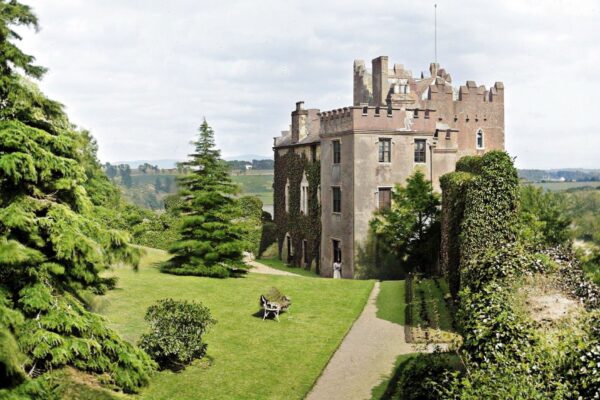
The castle's origins likely date to the fourteenth century, with local tradition attributing its construction to O'Maher, Chief of Hy-kerrin. By 1640, ownership had passed to Piers Lord Viscount, and the Civil Survey of 1654-6 recorded it as a manor with the prestigious privileges of holding Court Leet and Baron. Though described as "wanting repayre" at that time, the castle remained inhabited, its weathered walls bearing witness to multiple phases of rebuilding throughout the fifteenth and sixteenth centuries.
The castle's architecture reveals a fascinating evolution of defensive and domestic features. The main structure comprises a rectangular three-storey building with an attic, measuring approximately 10.8 by 8.9 metres, built from roughly coursed limestone rubble with thick walls spanning 1.8 metres. A four-storey circular tower guards the north angle, its 6.4-metre diameter bulk pierced by cross-loops with circular openings at their bases; a design feature shared with Clonmore Castle in County Carlow. The tower retains two circular vaults, one at ground level and another at the third floor, whilst spiral stairs accessed from the first floor wind upward on an external squinch with a relieving arch. These stairs display fine craftsmanship, with vertical punch dressing on the newel, a decorated moulded base, and drafted margins around the doorways.
Later modifications tell their own story of changing times and needs. Sixteenth and seventeenth-century renovations saw the insertion of multiple fireplaces throughout both the main block and tower, including one with a cut-stone surround that has since collapsed and now lies scattered across the floor. These domestic improvements likely blocked original windows, as evidenced by a small flat-headed window at second-floor level where a fireplace once stood. The castle originally sat within a bawn, or fortified courtyard, with remnants of a curtain wall still visible extending from the northwest angle. Though the southern end of the main building has crumbled away and much of the defensive perimeter has vanished, what remains offers a remarkable glimpse into the layers of Irish castle life, from medieval stronghold to early modern manor house.