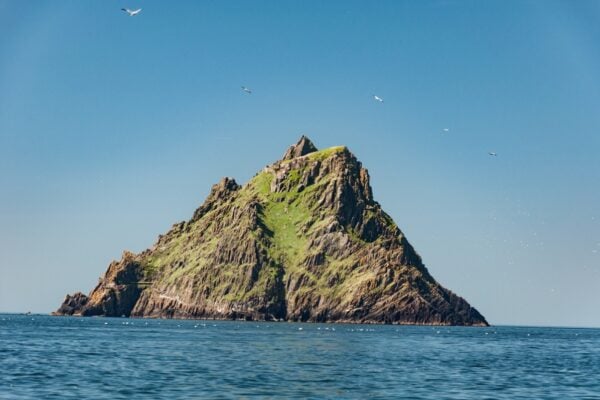
Church, Feaghmaan, Co. Kerry
Co. Kerry |
Churches & Chapels
A small ruined structure near Feaghmaan in County Kerry carries its ambiguity quietly.
What survives is modest almost to the point of invisibility: intermittent upright slabs set on edge along both faces of a rubble core, the whole thing averaging less than half a metre in height. The building measures roughly 4.75 metres east to west and 3.6 metres north to south, with a 0.7-metre entrance gap on the western side, flanked by a single upright to the north. It sits close to the eastern boundary of a surrounding enclosure, and it has been listed under the name of a church for long enough that the designation has stuck, even though the evidence for that identification is far from settled.
The question of what this structure actually was goes back at least to 1957, when the scholar Henry interpreted it as a possible oratory, a small private chapel of the kind associated with early Irish monasticism. But the construction method, those upright slabs forming the outer faces of the walls, bears a close resemblance to the technique used to build a leacht on the island of Illaunloughan nearby. A leacht is a low, altar-like cairn or slab monument, typically associated with early Christian devotional practice, sometimes marking a burial or serving as a focus for prayer. If the Feaghmaan structure is a leacht rather than a building with walls and a roof, then its footprint is not the ground plan of a small church at all, but the outline of something quite different in function and meaning. The resemblance to Illaunloughan, a site with well-documented early Christian remains off the Iveragh Peninsula, is what prompted that reinterpretation in more recent scholarship.
Visitor Notes
Added by