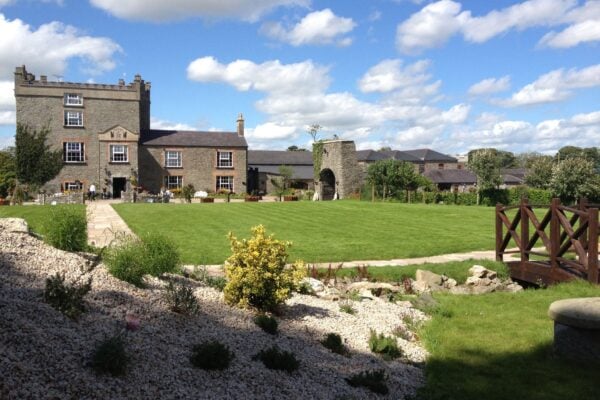
Ballug Castle, Ballug, Co. Louth
Co. Louth |
Tower Houses
Ballug Castle in County Louth stands as a compelling example of medieval Irish tower house architecture, though time and successive alterations have left it in a rather precarious state.
Built from roughly coursed rubble greywacke and limestone blocks, this defensive structure retains its eastern and southern walls almost intact, whilst the remainder of the building has suffered considerable deterioration. The most distinctive feature is the projecting tower at the southeast angle, which housed a stairwell providing access to two upper floor levels above the barrel-vaulted ground floor. Archaeological evidence suggests there may have been a matching tower at the northwest angle, likely serving as the location for the castle's garderobes.
The original entrance, documented in Wright's 1758 illustrations, pierces through the eastern end of the south wall and features surviving jambs of chamfered, punch-dressed limestone, though the arch stones have long since disappeared. Behind these jambs lies evidence of the castle's defensive capabilities; a bolt hole and a carefully constructed murder hole measuring approximately 0.4 metres square, through which defenders could attack unwelcome visitors below. The ground floor's barrel vault, oriented on a north-south axis, has largely collapsed, and modern openings have been cut through its eastern and western walls. The western portions of the structure are particularly ruined, with the remaining wall leaning at a dangerous angle.
The southeast angle tower reveals the sophistication of the castle's construction, with its stairwell built from well-dressed limestone blocks up to the first floor, then transitioning to sandstone for the upper levels. Single splayed window openings punctuate the stairwell, whilst the wall-walk consists of large, thin greywacke slabs cleverly sloped outward for drainage. Later modifications are evident throughout; a modern doorway was knocked through the eastern wall at first-floor level, accessed by external stone steps built over a ground-floor extension, presumably to convert the space for grain storage after the castle ceased to be a residence. The ruins of a later house remain attached to the tower's north wall, testament to the building's continued, if altered, use through the centuries.
Visitor Notes
Added by