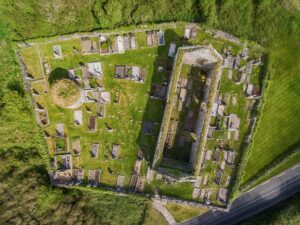
This is a ring barrow, a type of funerary monument associated broadly with the Bronze Age, consisting of a low bank of earth and stone enclosing a roughly circular interior, the whole thing serving as a burial marker of some kind, though the precise rituals involved varied considerably across time and place. What makes this one quietly compelling is its modest precision: a diameter of 8.5 metres from crest to crest, a bank that reaches its widest point of just over four metres at the base on the eastern side, and an interior that dips slightly inward in a shallow dish, with no definite inner edge to speak of.
The bank runs along the east, south, and west of the circuit, reaching an external height of around 0.6 metres. On the northern side, where the ground rises slightly, the bank gives way to a natural scarp, the higher terrain doing the work of enclosure that the built bank handles elsewhere. This is a detail worth pausing on: the monument's builders appear to have read the landscape carefully, using the topography itself as part of the design rather than imposing a uniform structure regardless of what the ground was doing. The field it sits in is fertile pasture, the lower slopes of the surrounding hillside poorly drained, and the position at the upper edge of the slope gives clear views southward, a siting choice that turns up again and again at prehistoric monuments across Ireland.
The perimeter is slightly overgrown in places but remains clearly visible, with small gaps around the circuit. The interior retains its dished form, which is often a sign that the monument has not been heavily disturbed, though no excavation has been recorded here to confirm what, if anything, lies beneath the surface.