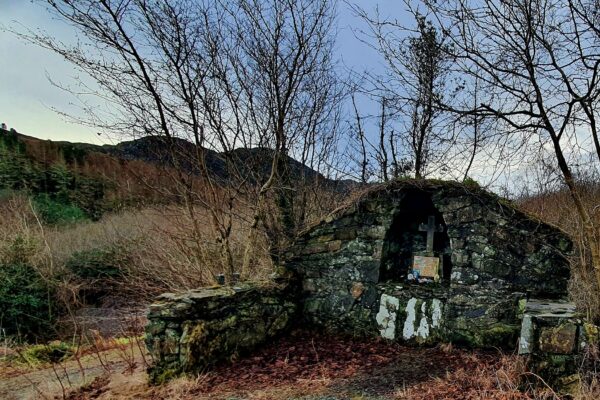
Bullaun stone, Drumcavany, Co. Donegal
Co. Donegal |
Holy Sites & Wells
On a modest ledge of rock outcrop in County Donegal, two curious circular depressions mark what locals have long called St. Columbkille's footprints.
The ledge itself stretches about two metres in length, whilst each depression measures roughly 33 centimetres across and 10 centimetres deep. These bowl-like hollows, known as bullaun stones, are found scattered throughout Ireland and often carry religious associations, particularly with early Christian sites and local saints' traditions.
The connection to St. Columbkille, also known as St. Columba, reflects the saint's deep roots in Donegal, where he was born around 521 AD before founding his famous monastery on Iona. Local folklore surrounding these stone depressions typically suggests they were formed when the saint knelt or stood in prayer, though archaeologists recognise them as prehistoric features that were later incorporated into Christian tradition. Bullaun stones likely served practical purposes in earlier times; perhaps for grinding grain or herbs, or holding water for ritual purposes, before becoming associated with healing properties and pilgrimage traditions in the Christian period.
At Drumcavany, these particular examples join hundreds of similar stones found across Ireland, each with their own stories and supposed curative powers. Many bullaun stones were believed to hold rainwater that could cure various ailments, from warts to rheumatism, and the association with St. Columbkille would have only enhanced their perceived potency. The site represents a fascinating blend of prehistoric craftsmanship and medieval religious tradition, where ancient stone working met Christian storytelling to create something uniquely Irish.
Visitor Notes
Added by