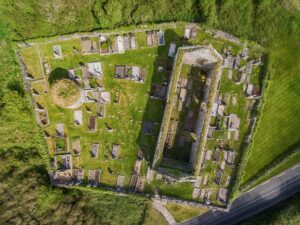
Roughly subcircular in shape, it measures about ten metres east to west and nine metres north to south, rising to between one and one and a third metres at its highest point. Two slight hollows mark the surface, the kind of depressions that often indicate earlier digging or the slow settling of whatever lies beneath. A cairn, in the Irish prehistoric context, is typically a mound of stones or earth raised over a burial, though the interior of this one remains uninvestigated.
The site has attracted notice for well over a century. Thomas Westropp, the Clare-born antiquarian who spent much of the late nineteenth and early twentieth centuries documenting the monuments of Munster, noted it on his personal copy of the Ordnance Survey six-inch map, as well as on a Geological Survey of Ireland map. By 1996 it had been formally classified as a tumulus in the Record of Monuments and Places. What satellite imagery has since revealed adds an unexpected layer: a grass-covered field wall extends from the western edge of the cairn towards the northwest, suggesting the mound was incorporated at some point into a field system, its ancient outline absorbed into the practical geometry of farming. The cairn does not stand in isolation in a wider sense either. A second cairn lies roughly thirty-five metres to the south-south-west, and a third around seventy-seven metres to the south-west, hinting that this rise in the landscape once held some sustained significance, the individual monuments clustering in a way that was probably deliberate rather than coincidental.