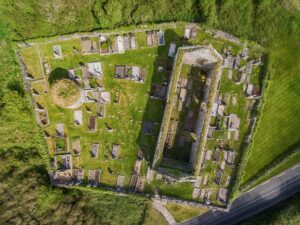
A cairn, in its most general sense, is a deliberate mound of stones raised over a burial or as a monument, and the Burren holds an unusual concentration of them, scattered across a terrain that seems almost to resist time. The exposed karst limestone, with its cracked pavements and thin soils, has preserved prehistoric structures here with a clarity that more vegetated landscapes tend to obscure.
Parknabinnia itself is a townland name that carries the older Irish landscape within it, and the presence of a recorded cairn there places it in the company of the Burren's broader megalithic tradition, which reaches back to the Neolithic period, roughly four to six thousand years ago. The wider area around Carron and the central Burren is known for wedge tombs, portal tombs, and field systems that predate written history by millennia. A cairn in this context was rarely accidental; the placement of stone upon stone in these upland settings almost always reflects deliberate choice, whether for burial, boundary-marking, or commemoration.