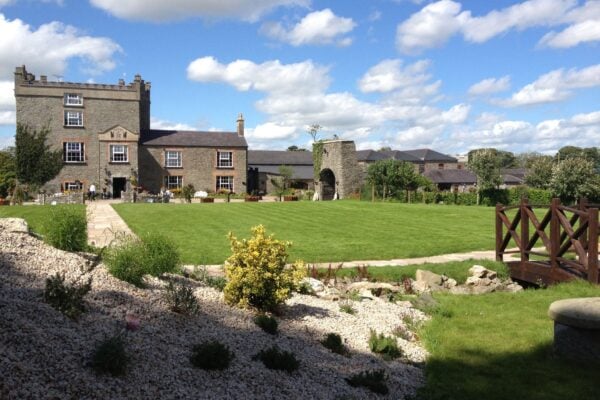
Castle Cave, Killincoole, Co. Louth
Co. Louth |
Tower Houses
Castle Cave in Killincoole, County Louth, stands as a remarkable example of a medieval tower house, rising four storeys high with distinctive projecting angle towers at its northeast and southwest corners.
Built on solid bedrock using rough coursed limestone blocks and greywacke, this fortress demonstrates the defensive ingenuity of its era. The southwest tower cleverly houses the garderobes whilst its diagonal opposite contains the spiral stairwell that once provided access to all levels, including the wall walk. The original entrance, located in the east wall just south of the northeast tower, has been modified over time; it was blocked when a building was attached to the eastern wall, prompting the creation of a new entrance slightly further south, along with modern stairs inserted through the southwest tower to reach the first floor.
The interior reveals fascinating medieval construction techniques, particularly the barrel vault over the ground floor which runs on a north to south axis and still retains some of its original wicker centring in the northwest portion. Each floor served distinct purposes: the first floor features a large fireplace in the east wall and a garderobe chamber with thoughtfully designed seating space around the chute; the second floor contains another substantial fireplace and a small guardroom that likely monitored access from the stairwell; whilst the third floor includes a garderobe chamber with an impressive beehive roof constructed from large stone slabs. Murder holes positioned above the main entrance and between the doorway and barrel vaulted area provided additional defensive capabilities.
One of the tower's most intriguing features is a carved stone human head adorning the south face of the southeast angle at first floor level. Though weathered by time and stained by tree foliage, the carving clearly depicts a face with a flattened chin, slightly bulging eyes, a pointed nose and a bald head; a curious decorative element that adds character to this formidable structure. Despite being adapted for farm use in more recent times and roofed with slates, the building now stands unused and is gradually deteriorating, its angles still showing evidence of where they once rose above the wall tops to accommodate the defensive wall walk that would have been crucial for surveillance and defence of the surrounding countryside.
Visitor Notes
Added by