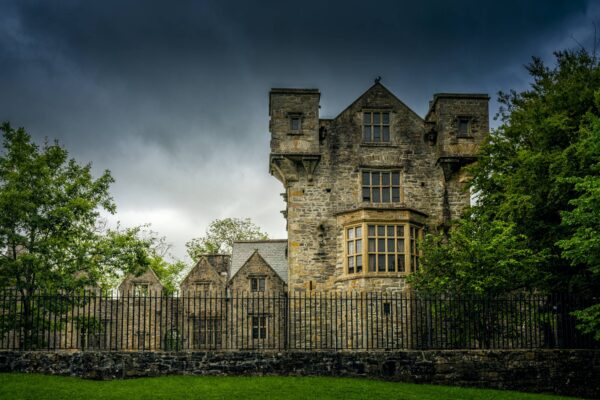
Castle - tower house, Rahan Near, Co. Donegal
Co. Donegal |
Tower Houses
Standing on a dramatic promontory in County Donegal, McSwyne's Castle tells a story of clan power, colonial change, and architectural salvage that spans five centuries.
The castle served as the principal stronghold of the McSwyne Bannagh chiefs, with Niall Mar McSwyne, grandson of the first Chief of Bannagh, dying within its walls in 1524. Built as a typical 15th or 16th century tower house, the keep once rose multiple storeys above the rocky outcrop, protected by sheer cliffs on three sides and a defensive fosse on the landward approach. The structure featured the characteristic elements of Irish tower houses: a spiral staircase in the southeast corner, corbelled floors, and a vaulted ceiling above the second floor, with narrow defensive windows set into thick rubble walls mortared with sea sand.
The castle's fortunes shifted dramatically during the Plantation of Ulster when it passed to John Murrey, later Earl of Annandale. By 1622, contemporary accounts describe it as 'a ruinous Castle Rahan' despite attempts at repair, including a newly built gatehouse and restored sections of the bawn wall that enclosed the promontory. The site witnessed military action during the 1641 rebellion when Sir Ralph Gore's regiment garrisoned the castle, but following the second Earl of Annandale's death in 1658 and subsequent legal disputes over the estate, it appears to have been abandoned. The defensive layout, with its promontory position and enclosing bawn wall, has prompted archaeological debate about whether earlier fortifications might have existed here before the medieval tower house was constructed.
Today, only a section of the south wall stands to its original height of over 10 metres, a lonely sentinel overlooking the sea. The castle's decline accelerated in the Victorian era when locals quarried its stones for St. Catherine's Catholic Church in Killybegs in the mid-19th century, with further material removed in 1872 to build Killybegs cemetery's boundary wall. Despite conservation efforts in 1929 to rebuild fallen window elements and stabilise the ruins, much of the bawn wall has since tumbled into the sea due to coastal erosion. A concrete observation post from more recent times now shares the promontory with these medieval remains, whilst grass-covered rubble and a modern drystone wall obscure much of the original defensive fosse that once protected the castle's vulnerable eastern approach.
Visitor Notes
Added by