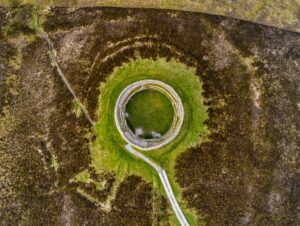
Marked as 'Castle in ruins' on early Ordnance Survey maps, this submerged artificial island revealed its secrets during low water levels in 1832 and 1848, offering Victorian antiquarians a rare glimpse into Ireland's layered past.
The structure itself tells a fascinating story of architectural evolution. At its base, investigators found an ingenious platform constructed from oak and willow beams, carefully notched and pinned together; a classic hallmark of crannog construction that dates back centuries in Irish lakelands. Built atop this wooden foundation stood something altogether different: an octagonal stone building, each of its eight sides measuring 10 feet in length and rising about 4 feet high, bound together with lime mortar. This unusual combination suggests the site began life as a traditional crannog, one of those defensive lake dwellings favoured by the Irish from the Bronze Age through the medieval period, before being repurposed for a stone structure, possibly a small tower house or fortified dwelling.
The artefacts recovered from the site paint a vivid, if somewhat grim, picture of life on this isolated stronghold. While no doorway was discovered, iron hinges and hooks indicated substantial wooden fixtures once existed. Among the finds were fragments of an iron hatchet, pottery shards, and the bones of sheep and deer, suggesting both domestic life and hunting activities. Most intriguing, however, was the discovery of a hefty pair of iron fetters, measuring over three feet long and weighing 10 pounds; a stark reminder that this remote island fortress may have served not just as a residence, but potentially as a place of imprisonment or detention during Ireland's turbulent medieval period.