Dovecotes were purpose-built structures for housing domesticated pigeons, which were kept as a reliable source of fresh meat and eggs during winter months when other food was scarce. Ownership of a dovecote was historically a privilege of the landed or ecclesiastical classes, and their presence on a site often signals proximity to a manor house, castle, or religious foundation.
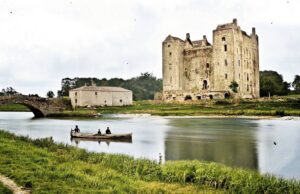
The antiquarian Thomas Johnson Westropp recorded the structure twice, noting in 1915 that 'beyond the church is the massive buttressed pier of the ancient pigeon house', and including it by name on a plan of Bunratty he published in 1917. What survives today is a ruined and overgrown stretch of roughly coursed limestone rubble: a section running south to north for about 2.1 metres, angling sharply at 45 degrees to the east for 1.5 metres, then continuing west to east for just over a metre, with a maximum surviving height of 3 metres. The interior no longer shows the characteristic nesting niches that would once have lined the walls of a functioning dovecote, though their absence may owe as much to the degree of collapse and vegetation cover as to any later alteration.