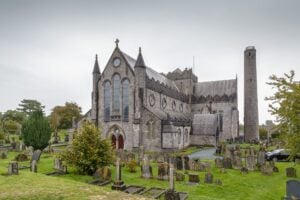
The site, known in its pre-Christian form as Cill Chainnigh, the Irish origin of the city's name itself, was once defined by at least two concentric enclosures. A fosse, the defensive or boundary ditch that typically surrounded such settlements, belonging to the innermost of these was uncovered in test-excavations by archaeologist Cóilín Ó Drisceoil in the area called the Deanery Orchard. That inner enclosure measured roughly 110 metres in diameter, enclosing just under a hectare. A second, much larger outer enclosure, measuring approximately 270 by 185 metres, has been proposed on the basis of the curving street lines of Thomas Street, upper Dean Street, Vicar Street, and the former Drysdal's Lane, though no archaeological evidence has yet confirmed that hypothesis.
The Deanery Orchard has had several lives. It appears as a large open space on John Rocque's 1758 map of Kilkenny, was divided by stone walls into three enclosures during the nineteenth century, and before that formed part of the plot of the manse house for the Precentor of the cathedral chapter. The Coach Road separating it from the Deanery was built in 1690. Deeper still, the excavations found a flat-bottomed fosse, six metres wide and nearly a metre deep, cut into natural gravel and later backfilled with a distinctive orange clay and gravel containing bone and antler working waste. Radiocarbon dating of a cess pit constructed into the backfilled fosse gives a date range of 690 to 890 AD, indicating the enclosure ditch had already been filled in before the ninth century. By the sixteenth or seventeenth century, the filled fosse lay sealed beneath a yard surface belonging to the Precentor's manse. Nearby, close to the fourteenth-century Bishop's Palace and just 22 metres north of the cathedral's north transept, a separate U-shaped fosse dated to roughly 980 to 1155 AD is interpreted as a sub-division of the outer zone of the settlement, a boundary within what early medieval ecclesiastical texts would have called the sanctior, the more sacred inner precinct. Elsewhere on the site, a souterrain (an underground stone-lined passage associated with early medieval settlements), a cess pit, pits containing tenth to twelfth-century craft waste, and human burials radiocarbon dated from the mid-seventh century onward all point to a busy, layered community occupying this ground for centuries. The round tower beside the cathedral is the only part of that early medieval settlement still visible above ground.