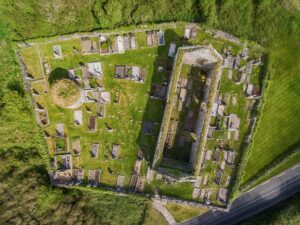
Enclosures of this type are among the most common yet least understood monuments in the Irish landscape. They might mark the boundary of an early medieval farmstead, a place of ritual significance, or simply a practical division of land whose original purpose has long since dissolved into the soil. What makes Baunkyle quietly interesting is precisely this ambiguity: a defined human boundary, drawn at some point in the distant past, still legible in the ground.
The townland name itself offers a small clue to character. "Baunkyle" likely derives from the Irish, combining elements suggestive of a wooded or enclosed area, which sits appropriately enough alongside the presence of a formal enclosure. Clare is a county whose archaeology ranges from the limestone pavements of the Burren, with their extraordinary density of ringforts and megalithic tombs, to the quieter, less-visited interior townlands where monuments receive far less attention. An enclosure in this context would typically consist of a raised earthen bank or a stone wall defining a roughly circular or oval space, sometimes associated with settlement activity dating from the early medieval period, roughly the fifth to the twelfth centuries, though some enclosures are considerably older.