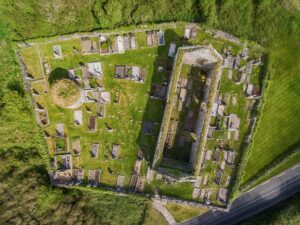
The interior measures roughly eleven metres northwest to southeast and nine metres northeast to southwest, and what remains of the wall is now a grass-covered tumble of stone, somewhere between one and one and a half metres wide and rarely more than forty centimetres high. Unassuming as it appears, one detail catches the eye of anyone who looks closely: a number of stones in the wall seem to have been deliberately positioned with their long axis pointing inward, toward the centre of the enclosure. Whether this reflects a structural technique or something more deliberate in intention is not recorded, but it gives the feature a quality that sits just outside the ordinary.
The enclosure belongs to a wider multiperiod field system, meaning the landscape around it has been shaped and reshaped across different eras, with boundaries, enclosures, and agricultural features accumulating over centuries or longer. This particular enclosure does not stand in isolation. Two other enclosures lie close by, one roughly twenty-seven metres to the south and another about forty metres to the north-northeast. A cairn, a mound of stones that in Irish archaeological contexts often marks a burial or acts as a landscape monument, sits around thirty metres to the west-northwest. Taken together, these features suggest that this fold in the hillside was a place of repeated human use and organisation over a long span of time, even if the precise dates and purposes of each element remain unresolved.