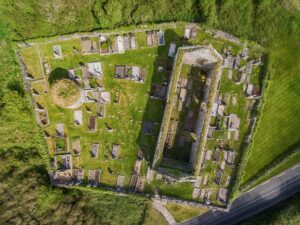
The site, known on nineteenth-century maps as 'Carrachantaggart' and on Tim Robinson's 1977 map as 'Cathracha an tSagairt', translates roughly as 'the priest's enclosure' or 'the priest's rocks', a name that places it firmly within the landscape of Penal-era Catholicism, when outdoor Mass sites served communities forbidden from open worship. The name may also apply to a mass rock recorded just to the north, a flat or prominent stone used as an improvised altar during that same period.
The enclosure itself is substantial: a roughly subrectangular space measuring around 57 metres north to south and 50 metres east to west, enclosed by a double-faced stone wall, meaning it was constructed with two dressed outer faces and a rubble core, a technique associated with more deliberate, often early medieval, construction. That wall has largely collapsed, spreading to a combined width of nearly five and a half metres in places, though it still stands to over a metre on the exterior at points. On the western side, the builders dispensed with a freestanding wall altogether, using instead the natural rock face of the steep ridge, which rises roughly ten metres here. The interior contains several features that add to the site's strangeness: a natural gryke, one of the solution fissures characteristic of Clare's limestone karst geology, cuts across the south-western interior, and a small stone cell sits tucked against the inner wall face at the south. A cave has also been reported within or immediately adjacent to the enclosure. A second, related enclosure lies only eighteen metres to the north-east, and both appear on Ordnance Survey maps from as early as 1842, suggesting the complex was already a recognised local landmark by the mid-nineteenth century. A later drystone wall, built over the probable outer wall-face on the southern side, points to continued use of the site in more recent centuries, layering still more history onto an already complicated ground plan.