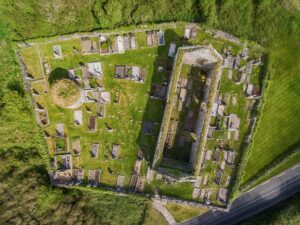
Together with an adjacent enclosure roughly eighteen metres to its west-southwest, the site is identified on nineteenth-century maps as 'Carrachantaggart', and on Tim Robinson's 1977 map as 'Cathracha an tSagairt', meaning roughly 'the priest's enclosures' or 'the priest's stone forts'. That placename, combined with the likely presence nearby of a mass rock, situates this site within the landscape of Penal-era Catholicism, when outdoor gatherings for Mass were a practical necessity rather than a choice, conducted at natural or improvised features in the countryside to avoid the restrictions placed on Catholic worship.
The enclosure itself is substantial. Its interior measures approximately 62 metres north-northwest to south-southeast and 41 metres across at the centre, making it a notably large example of its kind. It is defined by a double-faced drystone wall, the kind of construction in which two parallel outer faces enclose a rubble core, surviving to internal heights of between 0.4 and 0.8 metres and external heights reaching up to 1.6 metres in places, with associated collapse alongside it. Later activity has left its marks: a drystone wall built directly over the enclosure wall at the south, and a taller single wall, standing 1.8 metres high, constructed along the eastern perimeter. Against the inner wall-face at the west end of the north side, a rectangular structure has been built into the enclosure. The site appears on both the 1842 and 1920 editions of the Ordnance Survey, suggesting it was a recognised feature of the landscape across a long period. Cliffs lie to the west and north, giving the hollow a natural sense of enclosure even before the walls are taken into account.