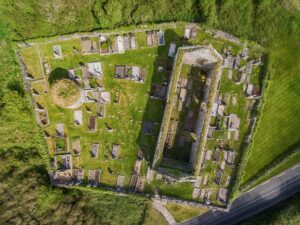
The south-east wall runs right to the edge of a natural scarp, dropping a metre and a half to the terraced ground below. It is the kind of place that reads, at first glance, as a field boundary, until you notice what is inside.
The enclosure measures roughly 69 metres on its north-east to south-west axis and 50 metres across, making it a substantial structure by any standard. It appears on the Ordnance Survey six-inch maps of both 1842 and 1920, and on Tim Robinson's 1977 map of the area it carries the name Lios Gaeilge, an Irish-language term for a lios, the type of enclosed settlement associated with early medieval Ireland. Running through the southern centre of the interior is a double-faced wall, about 1.2 metres wide and still 0.6 metres high, with considerable tumble spread around it, suggesting something older and more deliberate than a later field division. More telling still is the presence of a souterrain, roughly 10 metres north of this internal wall. A souterrain is an underground stone-lined passage, typically associated with early medieval settlement sites in Ireland, used variously for storage, refuge, or ventilation. This one sits in the north-east corner of a natural hollow or possible quarry roughly 25 by 15 metres across. A second hollow is visible in the southern part of the enclosure, and spreads of stone lie against the inner face of the north-east wall and along the exterior near the northern end, all hinting at structures and activity long since collapsed into the ground.