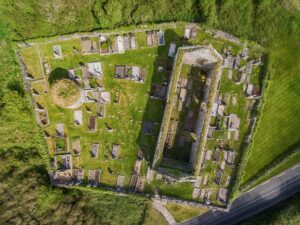
What makes it worth pausing over is the detail buried in its fabric: some of the stones within the bank appear to have been burnt or crushed, a detail that gestures towards human activity whose nature remains unresolved, but which suggests the site is older and more purposeful than its modest profile implies.
The earthwork was first formally noted as an enclosure by Tom Coffey in 1994, and a closer inspection carried out in 1999 recorded a curving arc of bank running from east to south-west, with a chord of roughly twenty metres and a width of about 3.2 metres. The bank stands no more than half a metre high on the interior, and slightly less on the exterior, which gives some sense of how thoroughly time and agriculture have pressed it down. At the south-west end of the arc, a slight scarp sloping eastward was interpreted as a possible remnant of the original inner bank-face, suggesting the structure was once more formally defined. A separate stony bank, roughly 3.4 metres wide and between a quarter and half a metre high, extends southward from the south-south-east edge of the arc, and may itself be of ancient origin. Enclosures of this kind, ringforts or their earlier precursors, were once the basic unit of rural settlement across Ireland, built to define a farmstead, protect livestock, and mark out a family's territory in the landscape. Whether this particular example served such purposes, or something else entirely, the burnt and crushed stones leave the question pleasantly open.