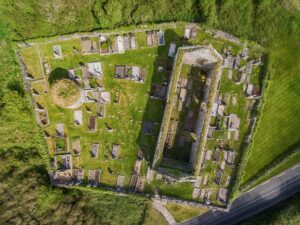
It is the kind of feature that tends to accumulate junk precisely because it has always been there, immovable and inconvenient, a fixed point around which farming life has arranged itself for longer than anyone can say. The enclosure itself, roughly subrectangular and measuring about 29.5 metres north to south and 28.2 metres east to west, sits on the east-facing slope of a reclaimed ridge surrounded by otherwise undrained marshy pasture, with open views to the east and south and higher ground pressing in from the west.
The site has a quietly shifting history on paper as well as on the ground. The first edition of the Ordnance Survey six-inch map, published in 1840, records it as a roughly subcircular enclosure, the kind of earthwork, defined by a low bank and interior ditch or scarp, that archaeologists associate broadly with early medieval settlement or enclosure in Ireland. By the 1916 edition, the same feature is depicted as more rectangular in plan, with hachures, the short lines used on older maps to indicate slopes and earthen banks, marking only the south, west, and north sides. That shift in recorded shape likely reflects both the real erosion of the monument and changing conventions in how surveyors chose to represent it. Today the eastern side has vanished entirely from the landscape, and what survives is a low earthen bank along the south and west, standing no more than 0.7 metres high, reducing to a scarp along the north. Two wide gaps punctuate the western bank, and two cattle gaps break the southern side, evidence of the enclosure's long second life as ordinary farmland. A collapsed and grass-covered stone wall runs internally from the central boulder toward the southern bank, and a disused, grass-grown pit lies about 26 metres to the south. Limestone erratics scatter the nearby fields, and an old dish-shaped quarry sits downhill to the south, adding to the sense of a landscape that has been worked, modified, and quietly forgotten over a very long period.