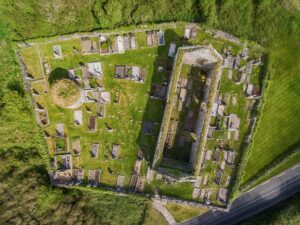
It is not especially large, roughly 17.5 metres north to south and 17 metres east to west, and its wall, built from slabs set on edge with their longer axes angled inward toward the centre, rises no higher than a metre. What makes it quietly interesting is the gap between what it appeared to be and what it most likely is.
When it was first catalogued in the Record of Monuments and Places in 1996, it was flagged as a possible hut site, the kind of designation that carries an implied antiquity. Karst terrain, with its limestone pavement, thin soils, and sparse vegetation, is the same landscape that elsewhere in the Burren conceals genuinely ancient structures, from megalithic tombs to early medieval enclosures. The association is understandable. But when the site was physically inspected in 1998, the assessment shifted: the construction style and materials pointed not to prehistory or the early medieval period, but to the eighteenth or nineteenth century. Drystone walling of that era is common across this part of Ireland, built by farming communities working with whatever the land offered, which in karst country means an abundance of loose limestone slabs. The enclosure at Parknabinnia is most likely agricultural in origin, its circular form shaped as much by the natural contour of the slope as by any deliberate geometric intent.